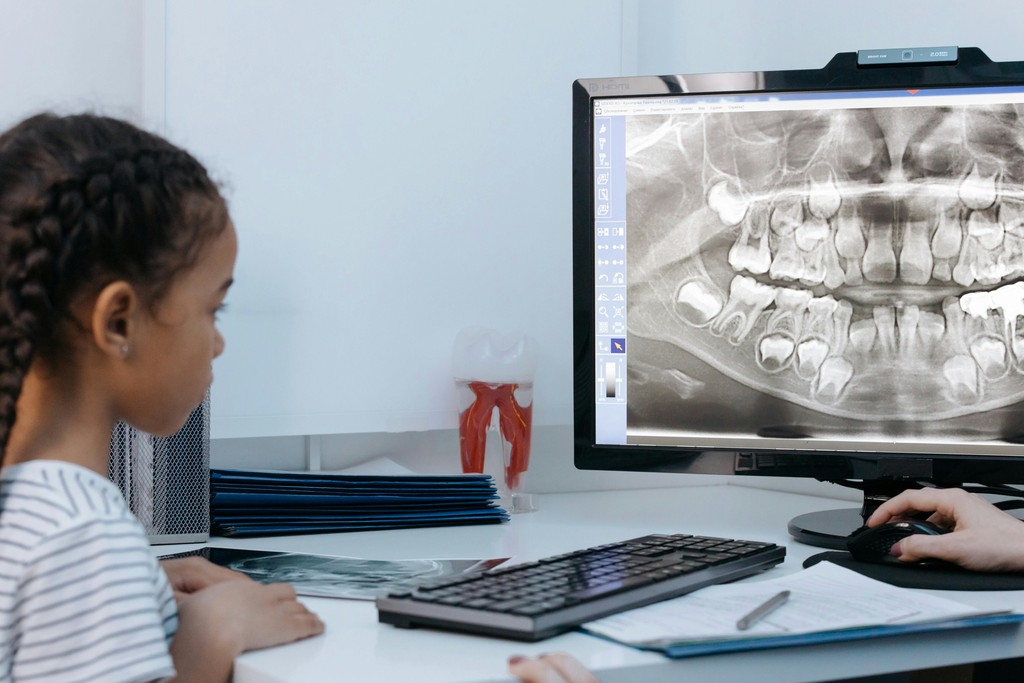
There is a phrase in paediatric medicine that every specialist in any discipline that treats children eventually internalises: children are not small adults. The anatomical, physiological, and developmental differences are not merely quantitative — they are qualitative. They change not just the dose of the treatment, but the treatment itself.
This is nowhere more true than in paediatric jaw fractures.
When this young boy was brought in following a trauma — his facial asymmetry visible even in the frontal photograph, and his malocclusion (the fact that his upper and lower teeth no longer met correctly) immediately apparent on examination — the clinical priority was clear: we needed to reduce and stabilise the fracture. But how we did it had to account for one critical biological reality: this child's jaw was still growing, and embedded within it were the developing tooth buds of all his permanent teeth.
Why Titanium Plates Are Not the Answer in Children
In adults, jaw fractures are most commonly managed with rigid fixation: titanium plates and screws applied directly to the bone, holding the fracture segments in anatomical alignment as the bone heals. This is the gold standard for adult mandibular fractures, and it works beautifully.
In children, the same approach carries significant risks. The screw fixation required to anchor titanium plates must pass through bone — bone that, in a child, is filled with developing tooth follicles. A screw placed incorrectly can damage or destroy a permanent tooth bud before it has ever had the chance to erupt. Additionally, titanium plates do not grow. A rigid implant placed across a growing jaw will create areas of restricted growth, potentially causing the very asymmetry it was meant to correct.
The guiding principle in paediatric jaw fracture management is therefore: use the fewest implants necessary and prefer tooth-borne fixation when available.
The Cap Splint: Elegant, Conservative, Growth-Friendly
For this patient, we used a cap splint — custom-fabricated acrylic appliances that fit over the teeth of both the upper and lower jaws and are wired together to immobilise the jaw in the correct occlusal position. The child's own teeth act as the anchor points. No plates. No screws through bone. No risk to developing tooth buds.
The cap splint works by taking advantage of the child's most stable anatomical feature — the teeth and their supporting bone — and using them as a natural framework for immobilisation. By wiring the upper and lower splints together (a technique called intermaxillary fixation), the fracture segments are held in alignment while bone healing occurs.
The pre-operative occlusion photograph clearly demonstrates the malocclusion — the misalignment of upper and lower teeth that indicates a displaced fracture. The cap splint photograph shows the appliance in place, and the post-operative OPG confirms the fracture reduction with the splint maintaining correct alignment.
The Child's Healing Advantage
One of the biological advantages of paediatric fracture management is that children heal faster than adults. Bone remodelling in children is significantly more active than in mature bone, meaning that fracture healing is typically complete in three to four weeks — compared to six weeks or more in adults. This shorter immobilisation period means that the period of jaw fixation (during which the child can only take liquid or soft food) is minimised.
This patient's jaw healed correctly. The fracture consolidated with the teeth in proper occlusal alignment. The permanent dentition was unaffected.
For Referring Practitioners
Paediatric jaw trauma should be referred to an oral and maxillofacial surgeon early — ideally within 24 to 48 hours of the injury. The treatment window for conservative management is not unlimited. As fracture organisation begins and early callus forms, reduction becomes progressively more difficult.
Please also remember: malocclusion after facial trauma is a fracture until proven otherwise.
— Dr. Hema | Oral & Maxillofacial Surgeon | Hyderabad
Let's talk about your case
Whether you're a patient researching options, a family member trying to understand a diagnosis, or a GP or dentist with a complex referral — reach out.

Let's talk about your case
Whether you're a patient researching options, a family member trying to understand a diagnosis, or a GP or dentist with a complex referral — reach out.
Let's talk about your case
Whether you're a patient researching options, a family member trying to understand a diagnosis, or a GP or dentist with a complex referral — reach out.