It started as a subtle swelling in her lower jaw. Not painful enough to panic, not obvious enough to raise immediate alarm — just a slow, persistent change that she had been watching for months before she finally walked into my clinic. When I examined her that day, the worm's eye view told me what the front view had only hinted at: the lower jaw was significantly expanded. Whatever was growing inside it had been doing so quietly, patiently, and without announcing itself.
This patient had an ameloblastoma of the mandible. Let me explain why this particular tumour deserves your full attention.
What Is an Ameloblastoma?
Your teeth form because of specialised cells called ameloblasts — enamel-producing cells that are active during early tooth development and then, in a healthy jaw, essentially retire once their job is done. In an ameloblastoma, these cells don't retire. They proliferate into a tumour that grows within the jawbone itself, slowly expanding it from the inside — like a balloon being inflated within a rigid box.
The result is a jaw that grows progressively larger, over months or years, often without causing significant pain. And that silence is precisely what makes this tumour dangerous. Patients delay seeking care because nothing hurts. But here is the clinical truth: ameloblastoma is classified as a benign tumour, yet it is locally aggressive. Left untreated, it destroys bone, invades adjacent structures, and carries a high recurrence rate if not completely removed.
How Was It Diagnosed?
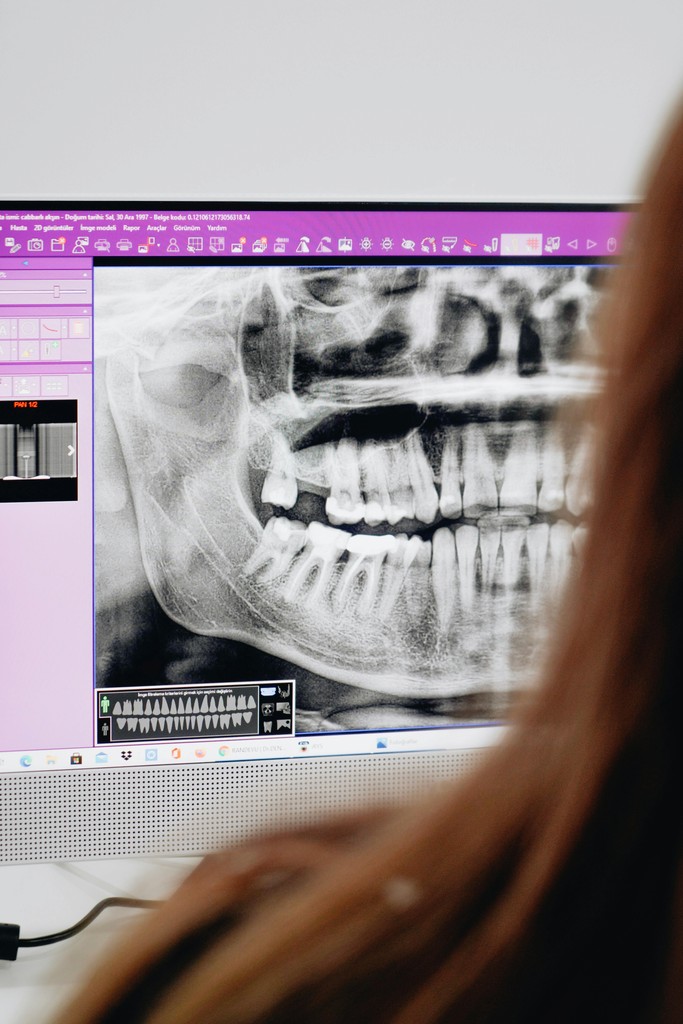
In this patient's case, diagnosis was established through a combination of clinical examination, OPG (panoramic jaw radiograph) showing a characteristic multilocular "soap bubble" radiolucency within the mandible, and histopathological confirmation after biopsy. The imaging revealed how extensively the tumour had involved the mandibular bone — a finding that was striking even on the two-dimensional X-ray.
What struck me most during the clinical examination was the worm's eye view — a perspective most patients never see of themselves, but one that immediately reveals to a surgeon how much the jaw architecture has been altered. The symmetry was gone. The mandible had been quietly remodelled by something that needed to come out.
The Surgical Approach
We approached the tumour entirely intraorally — through the mouth — which meant no external scars for this patient. Once the mucosa was incised and the full-thickness flap reflected, the pathology was right there: a tumour that had expanded the buccal cortex of the mandible significantly. We excised the lesion in its entirety, performing a peripheral ostectomy — careful shaving of the surrounding bone margins — to reduce the risk of recurrence. This step is not optional. It is the difference between a surgery that holds and one that requires a revision.
The excised specimen was larger than it appeared from the outside. This is almost always true with jaw tumours. What you see on the surface reflects perhaps half of what the imaging and surgery reveal. Histopathology confirmed the diagnosis: ameloblastoma.
Why Margin Management Is Everything
Ameloblastoma has a documented recurrence rate of 15% to over 50% with conservative management alone, depending on surgical technique and extent of disease. This is why I am meticulous about margins. A tumour that grows back doesn't just mean a second surgery — it means a second, more complex surgery on tissue that has already been operated upon. The first surgery has to be the definitive one.
What Should You Watch For?
For patients: any slow-growing jaw swelling — even a painless one — deserves proper evaluation by an oral and maxillofacial surgeon. Pain is not a reliable indicator of severity in jaw lesions. The absence of pain has misled countless patients into delayed presentation.
For referring dentists and general practitioners: when a panoramic radiograph shows a multilocular radiolucency in the mandible, please refer early. Ameloblastomas managed before they destroy significant bone are far more amenable to conservative surgical approaches, sparing the patient the need for jaw resection and reconstruction.
This patient recovered well. Her jaw healed. She came back to tell me that the swelling she had been dismissing for so long had finally, completely, disappeared.
That is what we are here for.
— Dr. Hema | Oral & Maxillofacial Surgeon | Hyderabad
Let's talk about your case
Whether you're a patient researching options, a family member trying to understand a diagnosis, or a GP or dentist with a complex referral — reach out.

Let's talk about your case
Whether you're a patient researching options, a family member trying to understand a diagnosis, or a GP or dentist with a complex referral — reach out.
Let's talk about your case
Whether you're a patient researching options, a family member trying to understand a diagnosis, or a GP or dentist with a complex referral — reach out.